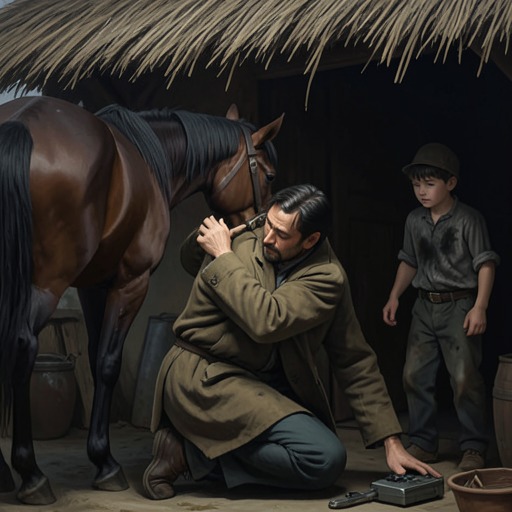
Black Beauty and John Manly as Horse and Stableman
Black BeautyBlack Beauty and John Manly are horse and stableman, but their relationship grows beyond the duties of handling and grooming. John’s careful attention teaches Black Beauty to trust his touch and understand his guidance, while Black Beauty’s reliable work gives John a valued and responsive partner. Their strongest bond is shown in practical acts of care: John fits equipment to the horse, recognizes his distress, and tends him after an exhausting emergency ride. When John must leave, the horse can offer only a quiet gesture of farewell, and the separation proves permanent.
Identity and Setting
John Manly is the coachman at the estate where Black Beauty lives. He has a wife and a young child, and they live in the coachman’s cottage close to the stables. His position brings him into regular contact with the horses, but his relationship with Black Beauty is marked by a personal attentiveness that exceeds routine handling.
John’s care is associated with a household where kindness to animals is treated as a shared responsibility. Black Beauty describes the people at Birtwick as considerate toward creatures in their care, and John stands out among them as a particularly capable groom. The horse comes to understand John not only through what he says but through the meaning of his actions and the way he handles him.
Daily Care and Growing Trust
John takes pains to make Black Beauty comfortable. Before a trial ride, he adjusts the bridle straps carefully to fit the horse’s head. When he sees that the first saddle is too narrow for Black Beauty’s back, he immediately goes to fetch another. The change is a small but telling act: John attends to the horse’s actual comfort rather than expecting him to endure ill-fitting equipment.
On that ride, John takes Black Beauty around the common and Highwood, then back by the watermill and river. He tests the horse’s paces at a measured sequence of walk, trot, and canter before letting him gallop on the common. The outing gives John a chance to assess his new horse, but it also establishes a working partnership based on responsive handling rather than force.
Their familiarity deepens through repeated contact in the stable. John grooms Black Beauty’s mane and tail and speaks to him often. Although the horse cannot understand every word, he gradually learns what John means and what he wants him to do. During grooming, John knows which places are tender and which are ticklish; when he brushes the horse’s head, he is especially careful around the eyes. Black Beauty grows fond of him because this carefulness makes the stableman’s touch predictable and kind.
The Emergency Ride and Its Cost
The relationship is tested when John is roused at night by the stable bell and told that Black Beauty must carry him urgently. The household needs a doctor for the mistress, and Squire Gordon sends John with a note for Dr. White, warning that there is no time to lose. John saddles the horse quickly and rides him out through the park and village, pressing on toward the doctor’s lodging.
The ride is an expression of trust on both sides: John depends on Black Beauty’s strength, and the horse responds to the urgency of the journey. John believes the horse will continue until he can go no farther and urges the doctor to take care of him. On the return journey, the doctor is heavier and less skilled a rider than John, and Black Beauty is already near exhaustion. A pause at the hill gives him time to recover his breath before they continue to the estate.
Black Beauty has carried the doctor back in time to save the mistress’s life, but the journey leaves him seriously unwell. His legs shake, he is drenched with sweat, and he can barely stand. John is not there immediately; Joe Green, still inexperienced, tends to the horse as best he can. When John returns, he understands from Black Beauty’s condition that he is in pain. He covers him with warm cloths, gets hot water, and prepares warm gruel. These actions contrast with the earlier care, which had failed to keep the exhausted horse warm, and show John’s close knowledge of what Black Beauty needs.
Nursing and Knowledge of the Horse
Black Beauty develops a severe inflammation in his lungs and struggles to breathe without pain. John nurses him day and night, sometimes getting up several times in the night to check on him. Squire Gordon also visits, and John reports how fast Black Beauty travelled. The horse understands the purpose of the ride as a journey to help the mistress, even though John had assumed that he did not know what was happening.
The illness makes John’s knowledge significant in more than a practical sense. He can recognize distress that Black Beauty cannot explain in human language, and he responds by changing the horse’s immediate care: warmth and nourishing gruel replace the cold water and insufficient protection he had received after returning. The episode does not erase the physical cost of the ride, but it shows John’s commitment to caring for the horse once its consequences become clear.
John’s concern also appears in his attention to Black Beauty’s recovery. A horse-doctor treats the illness, and Black Beauty remains weak enough that his condition causes serious alarm. John’s continued nursing gives the horse companionship as well as care. The relationship is therefore built not only in successful work but also in the vulnerable period when Black Beauty can no longer carry out his duties.
Departure and Lasting Significance
When the Gordon household leaves, John comes to each of the horses to pat them and speak to them for the last time. His voice sounds sad. Black Beauty presses his face close to John’s, the only farewell he can offer, and then John goes. Black Beauty never sees him again.
The separation gives the relationship a definite ending: the stableman who had been a daily presence becomes a remembered figure, not a companion who returns later in the story. Black Beauty’s farewell gesture echoes the quiet intimacy established through grooming and care. John’s importance rests on repeated, concrete acts—fitting the saddle, reading the horse’s discomfort, and nursing him after the night ride—through which trust becomes visible. Their bond also illustrates how a horse’s welfare depends on a human attendant’s observation and judgment, not merely on the work the animal can perform.